





6G, or the sixth generation of mobile communication technology, refers to the next-generation wireless communication system beyond 5G for the future information society. Compared with 4G, which mainly focused on high-speed mobile internet, and 5G, which is represented by enhanced mobile broadband, low-latency communication, and massive Internet of Things connectivity, 6G will further evolve toward a comprehensive information network with higher frequencies, larger bandwidths, lower latency, higher reliability, and stronger intelligence. It will not only support communication between people, but also serve real-time connections between humans and machines, between machines, and between the physical and digital worlds. Future 6G networks are expected to enable important application scenarios such as immersive communication, extended reality, holographic display, autonomous driving, smart manufacturing, the low-altitude economy, satellite internet, space–air–ground integrated networks, and integrated sensing and communication.
From a technological perspective, the development of mobile communication has always been accompanied by the pursuit of higher data rates and larger system capacity. With the rapid development of artificial intelligence, cloud computing, the Internet of Things, automated systems, and intelligent terminals, future wireless networks will need to connect massive numbers of devices while simultaneously supporting high-speed data transmission, precise positioning, environmental sensing, and intelligent decision-making in complex environments. Traditional wireless communication systems mainly undertake the function of information transmission, whereas 6G is evolving toward the deep integration of communication, sensing, computing, and intelligence. In other words, future wireless networks will not only transmit bits, but also sense space, understand environments, coordinate computation, and support the real-time operation of complex intelligent systems.
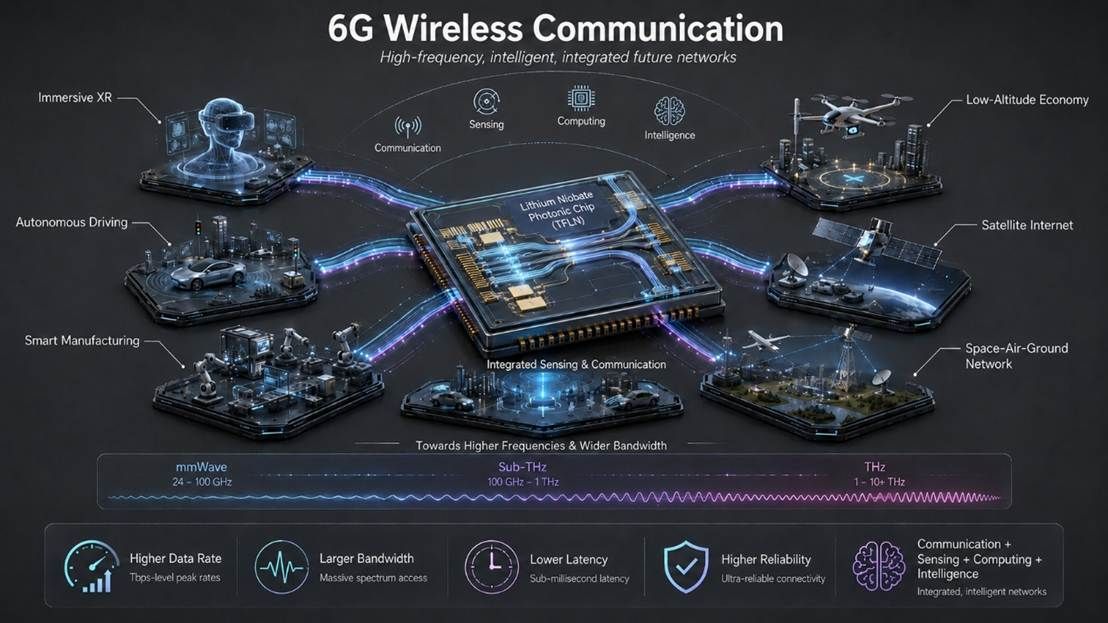
To achieve these goals, 6G and wireless communication technologies are expanding toward millimeter-wave, sub-terahertz, and terahertz frequency bands. Higher carrier frequencies make it possible to access broader spectral resources, thereby supporting larger communication bandwidths and higher data transmission rates. For example, millimeter-wave and terahertz bands can provide important support for ultra-high-speed wireless links, short-range high-capacity communication, high-resolution radar sensing, and high-precision positioning. At the same time, shorter wavelengths are also favorable for miniaturized antenna arrays and highly directional beam control, opening new possibilities for future phased-array communication, intelligent reflecting surfaces, and spatial multiplexing technologies.
However, increasing the operating frequency also brings significant technical challenges. In the millimeter-wave, sub-terahertz, and terahertz bands, conventional electronic devices and circuits are limited by bandwidth, loss, noise, power consumption, and system complexity in signal generation, modulation, mixing, filtering, phase control, and long-distance transmission. High-frequency electrical signals suffer significantly increased loss in metallic transmission lines and cables, and the design of broadband radio-frequency devices also becomes more difficult. Meanwhile, future 6G systems will need to support multiple frequency bands, multi-channel parallel transmission, dynamic spectrum allocation, and complex beam control, which further increases the complexity of wireless front ends and signal-processing systems. Therefore, realizing stable, reconfigurable, and integrable wireless communication functions under high-frequency, large-bandwidth, and low-power conditions is a key challenge in the development of 6G.
Microwave photonics provides an important technological route for 6G and wireless communication. Optical carriers have extremely high frequencies and inherently ultra-large bandwidths, while optical fibers and integrated photonic devices offer low loss, immunity to electromagnetic interference, and convenient multi-channel multiplexing. By loading microwave, millimeter-wave, or terahertz signals onto optical waves, signal generation, modulation, frequency conversion, filtering, delay, phase control, and distribution can be performed in the optical domain, before being converted back into electrical or wireless signals through photodetection. Compared with approaches that rely entirely on electronics, microwave photonic systems are expected to show advantages in ultra-broad bandwidth, high operating frequency, low phase noise, multi-channel parallel operation, and long-distance distribution.
In 6G and wireless communication, microwave photonics can play multiple roles. First, it can be used to generate high-frequency wireless carriers. Through optical heterodyne beating, optical frequency combs, or electro-optic modulation, stable signals at millimeter-wave or even terahertz frequencies can be generated, providing high-quality signal sources for high-speed wireless links and radar systems. Second, it can be used for broadband signal processing, including microwave photonic filtering, frequency conversion, optical delay, arbitrary waveform generation, and spectrum analysis. Third, it can support optically assisted wireless links, connecting data centers, base stations, antenna arrays, and remote wireless nodes through optical networks to realize low-loss, high-capacity, and flexibly tunable signal distribution. For future integrated sensing and communication systems, microwave photonics can also support the generation and processing of both broadband communication signals and high-resolution radar waveforms.
An important development trend in 6G and wireless communication is the convergence of communication and sensing. Traditional communication systems mainly focus on information transmission, while radar and sensing systems mainly focus on target detection and environmental perception. Future 6G networks aim to realize communication and sensing functions simultaneously using the same hardware and spectrum resources. For example, base stations may not only transmit data, but also sense the surrounding environment, identify target locations, track motion states, and provide real-time information for autonomous driving, low-altitude aircraft, intelligent transportation, and industrial robots. To realize this goal, systems need large bandwidth, multiple channels, high coherence, and flexible waveform-control capabilities. Optical frequency combs, multi-wavelength optical carriers, high-speed electro-optic modulation, and on-chip photonic signal processing provide important technological foundations for such systems.
Another development direction of 6G and wireless communication is optical–wireless converged networks. Future networks may no longer consist of a single type of wireless link, but instead may be jointly formed by fiber-optic communication, free-space optical communication, millimeter-wave communication, terahertz communication, satellite communication, and terrestrial cellular networks. High-speed, low-loss, low-noise, and reconfigurable signal conversion and distribution will be required among these different links. Photonic technologies are naturally suitable for high-speed backbone transmission and multi-channel signal distribution, while wireless technologies are well suited for flexible access and mobile coverage. Therefore, the deep integration of optical and wireless technologies will become an important feature of future 6G network architectures.
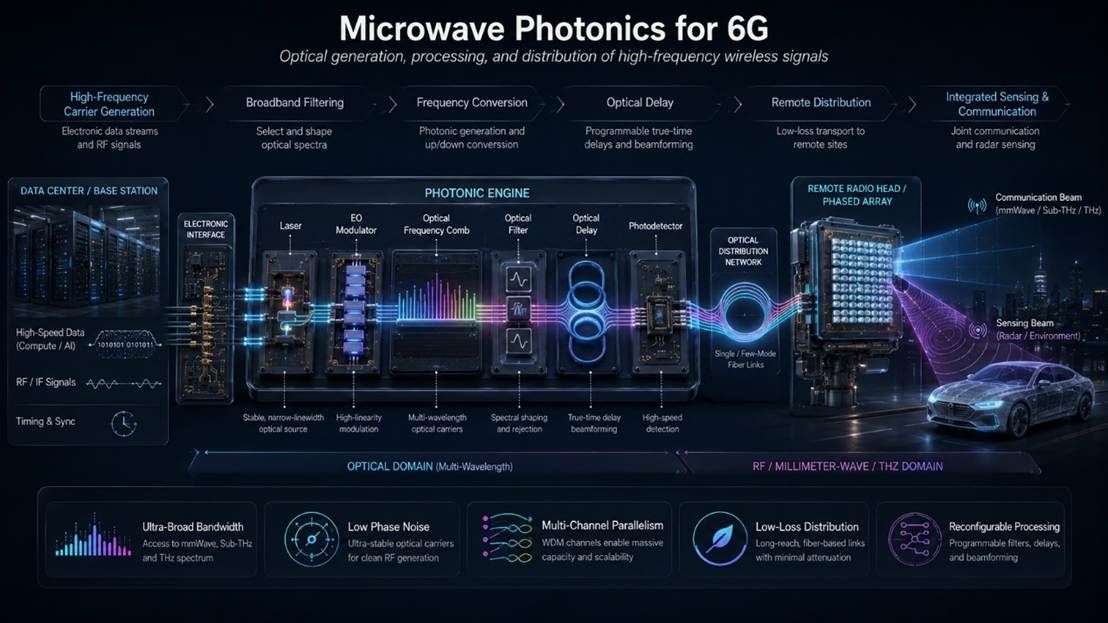
Driven by these technological demands, thin-film lithium niobate, or TFLN, has gradually emerged as an important integrated photonic platform for supporting 6G and wireless communication. Lithium niobate is an optical material with strong second-order nonlinearity and a strong electro-optic effect, enabling efficient mutual control between electrical and optical signals. Conventional lithium niobate modulators have long been used in high-speed optical communication systems, while thin-film lithium niobate further combines lithium niobate materials with nanophotonic integration technologies. This allows optical fields to be strongly confined in micro- and nanoscale waveguides, thereby significantly enhancing the interaction between optical waves and microwaves.
The thin-film lithium niobate platform simultaneously offers low optical loss, high electro-optic modulation efficiency, large modulation bandwidth, and good on-chip integration capability. By designing low-loss optical waveguides, high-Q optical resonators, traveling-wave electrodes, and microwave transmission structures, TFLN chips can realize functions such as high-speed electro-optic modulation, optical frequency comb generation, optical frequency conversion, and microwave photonic signal processing. These capabilities are highly consistent with the demands of 6G and wireless communication for high frequency, large bandwidth, low noise, low power consumption, and miniaturized systems.
In 6G-related applications, TFLN can be used to construct on-chip high-frequency signal sources. Through electro-optic modulation and optical heterodyne beating, stable millimeter-wave and terahertz signals can be generated in the optical domain. Through electro-optic frequency combs, multi-wavelength and multi-channel optical carriers with precisely controllable frequency spacing can be produced, providing a foundation for parallel wireless links, wavelength-division multiplexed communication, and multi-channel radar sensing. Compared with conventional electronic frequency multiplication or mixing schemes, TFLN-based photonic generation of high-frequency signals offers greater bandwidth potential and stronger reconfigurability.
TFLN can also be used to realize on-chip microwave photonic signal processing. By combining high-speed electro-optic modulators, on-chip resonators, tunable optical filters, and optical delay structures, functions such as broadband filtering, frequency conversion, phase control, waveform shaping, and spectrum analysis can be implemented. These functions are important for dynamic spectrum management, anti-interference communication, phased-array beam control, broadband radar, and integrated sensing and communication. As device integration continues to improve, complex systems originally composed of multiple discrete optical and radio-frequency components may be compressed into miniaturized, low-power, and packageable photonic chips.
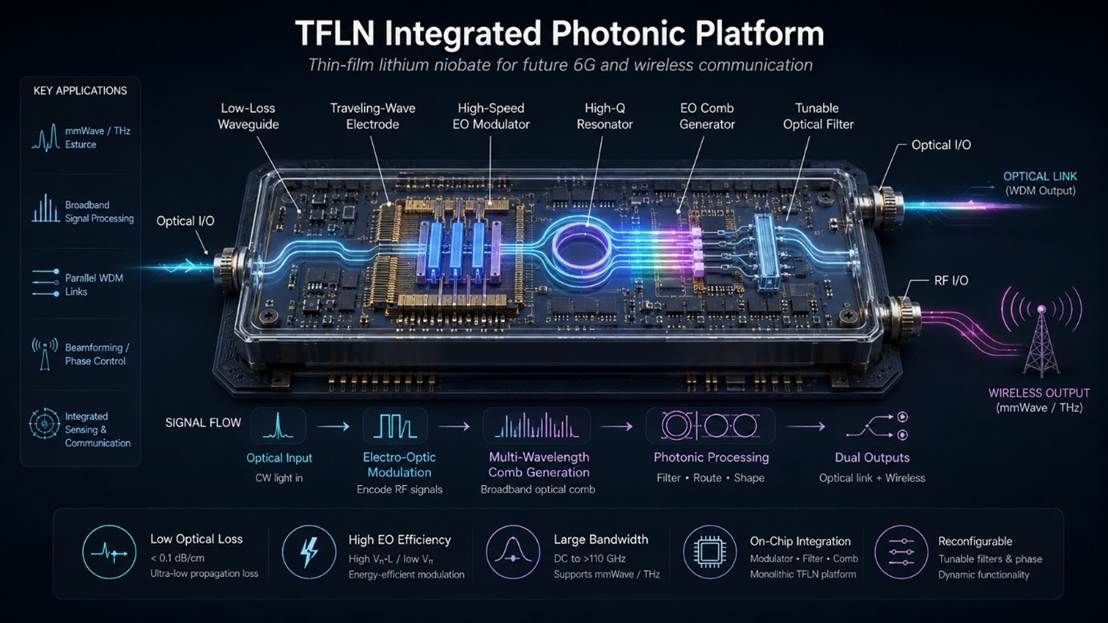
Overall, 6G and wireless communication are moving from traditional radio-frequency electronic systems toward a new stage of optoelectronic convergence, communication–sensing convergence, and intelligent network convergence. Higher operating frequencies, larger system bandwidths, and more complex application scenarios impose new requirements on underlying devices and system architectures. With its strong electro-optic effect, low-loss nanophotonic structures, and compatibility with high-speed microwave engineering, thin-film lithium niobate provides a highly promising chip-scale technology platform for future 6G wireless systems. TFLN-based integrated microwave photonic technologies are expected to play an important role in millimeter-wave and terahertz signal generation, broadband wireless communication, microwave photonic processing, radar sensing, optical–wireless converged networks, and intelligent information systems.